How Professionals Identify Hidden Poison Ivy Growth on Properties
Most homeowners can spot a cluster of three-leafed vines in the middle of an open lawn. What they tend to miss is the poison ivy that has been quietly spreading for years in the places they rarely look closely: climbing thirty feet up a mature oak, threading through an ornamental shrub border, or running along a fence line just below the level where the eye naturally falls. That hidden growth is exactly where the real problem lives, and it is also exactly what makes professional poison ivy removal in Southeast Pennsylvania worth considering over a weekend DIY effort.
Why Is Poison Ivy So Difficult for Homeowners to Find on Their Own?
Poison ivy is highly adaptable. It grows as a ground cover, a free-standing shrub, and a climbing vine, and it changes its appearance with each season. In spring, new leaves emerge with a reddish or bronze tint that can be easily mistaken for ornamental plants. By summer, the foliage turns green and blends into surrounding vegetation. In fall, leaves go yellow, orange, and red before dropping entirely, leaving behind a woody vine that looks, at first glance, like any other dormant growth.
Even when the plant is dormant and the leaves have fallen, the urushiol oil remains active and highly potent within the vines and roots. A homeowner doing fall yard cleanup, stacking firewood, or clearing a fence line in January can receive a full-strength exposure without recognizing the plant at all.
How Do Professionals Spot Poison Ivy That Most People Walk Past?
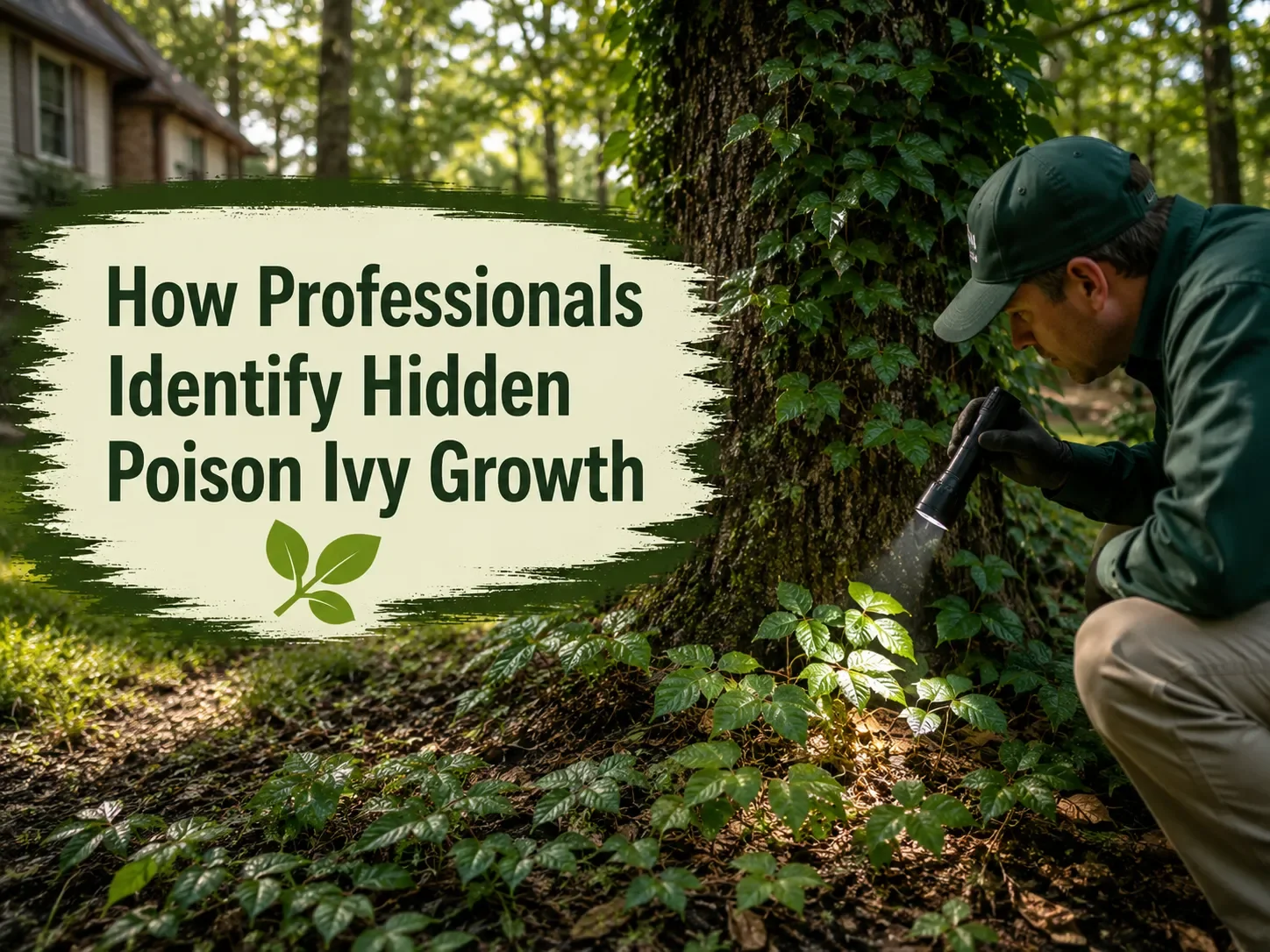
Trained crews know what to look for at every growth stage and in every form the plant takes. One of the most important identification skills for professional poison ivy removal in Southeast Pennsylvania is recognizing mature climbing vines during the dormant season, when leaves are absent and casual inspection would miss them entirely.
The most notable feature is the thick, woody stem covered in a dense growth of reddish-brown or gray root hairs. This "hairy" texture is a reliable identifier, particularly during the dormant season when leaves are absent. An experienced crew walking a property in November or February looks specifically at tree trunks for this signature texture. The trunks of older poison ivy vines can even reach up to six inches in diameter, making them substantial structural presences that have been feeding from the same root network for years.
Professionals also know the lookalike problem. Virginia creeper, climbing hydrangea, boxelder, and fragrant sumac are all commonly mistaken for poison ivy by homeowners, sometimes in both directions: treating a harmless plant, or more dangerously, leaving poison ivy alone because it was assumed to be something else. Accurate species identification is a core part of what separates a professional property assessment from a homeowner's walkthrough.
Where Are the Most Common Places Poison Ivy Hides on a Property?
The areas where poison ivy tends to thrive include fence lines, wooded areas, neglected corners, and areas where birds roost. Birds feed on the plant's white berries and deposit seeds across a property, which is why new growth can appear in locations completely separate from the original infestation.
Specific hiding spots that professional crews check during a property inspection include: the bases and trunks of mature trees, the inner structure of dense shrubs where three-leafed vines are shaded and hard to see, stone walls and retaining structures where ground-level vines thread through gaps, and the edges of lawn areas that border any unmaintained vegetation. In a typical residential property, a trained eye will find growth in two or three locations that the homeowner had no awareness of.
Does a Professional Assessment Include the Root System, Not Just Visible Leaves?
Yes, and that distinction matters significantly for long-term control. Professionals use targeted removal techniques that address the visible plant and the hidden root network so it does not return in a week or a season. Poison ivy spreads through underground rhizomes that can extend well beyond the visible above-ground growth, and a thorough assessment maps that spread rather than just treating the surface.
A landscape professional will assess the extent of the spread, the poison ivy species invading your land, and the best control and preventative measures to prevent the plant from returning after removal. This is particularly important in Southeast Pennsylvania, where properties with wooded borders or mature tree lines can harbor extensive root networks that have been expanding for multiple seasons without detection.
When Should You Schedule a Professional Property Inspection for Poison Ivy?
Any time, though early spring and late fall each have specific advantages. Spring inspections catch the plant as it leafs out and becomes easier to identify, while fall and early winter inspections are ideal for finding established climbing vines on tree trunks before they are obscured by surrounding foliage the following season.
If anyone in your household has had a reaction after spending time outdoors on your property, or if you have noticed three-leafed growth in more than one location over successive seasons, a professional inspection is the practical next step. The Safe Acres team provides professional poison ivy removal in Southeast Pennsylvania with the kind of thorough property assessment that actually finds what a casual inspection misses. Identifying hidden growth early is considerably easier, and less expensive, than managing a well-established infestation later in the season.