How to Control Poison Ivy Growth on Your Property in Delaware Valley

If you have a yard in the Delaware Valley, there is a decent chance poison ivy is already somewhere on it. It creeps along fence lines, climbs trees, spreads through garden beds, and hides at the edge of wooded lots. Most homeowners do not notice it until someone brushes past it and the rash shows up a day or two later.
Getting ahead of it takes the right approach, and that is exactly what effective poison ivy control in Delaware Valley is built around. Here is what actually works.
What Does Poison Ivy Look Like in Delaware Valley Yards?
Poison ivy grows in three forms:
a ground cover,
an upright shrub,
a climbing vine.
The leaves come in groups of three, often with a slightly glossy surface and pointed tips. In spring the new leaves are reddish. By summer they go green. In fall they turn yellow, orange, or red before dropping.
The vine form is the one most people miss. It climbs tree trunks using small, hair-like aerial roots that give the vine a fuzzy appearance from a distance. If you see a hairy vine on a mature tree in your yard, assume it is poison ivy until proven otherwise.
Why Does Poison Ivy Keep Coming Back Every Year?
The root system. Poison ivy spreads through underground rhizomes that branch wide and shallow beneath the soil. When you remove the visible plant and leave roots behind, those roots send up new shoots. The plant also spreads by seed, which birds carry onto your property from neighboring land.
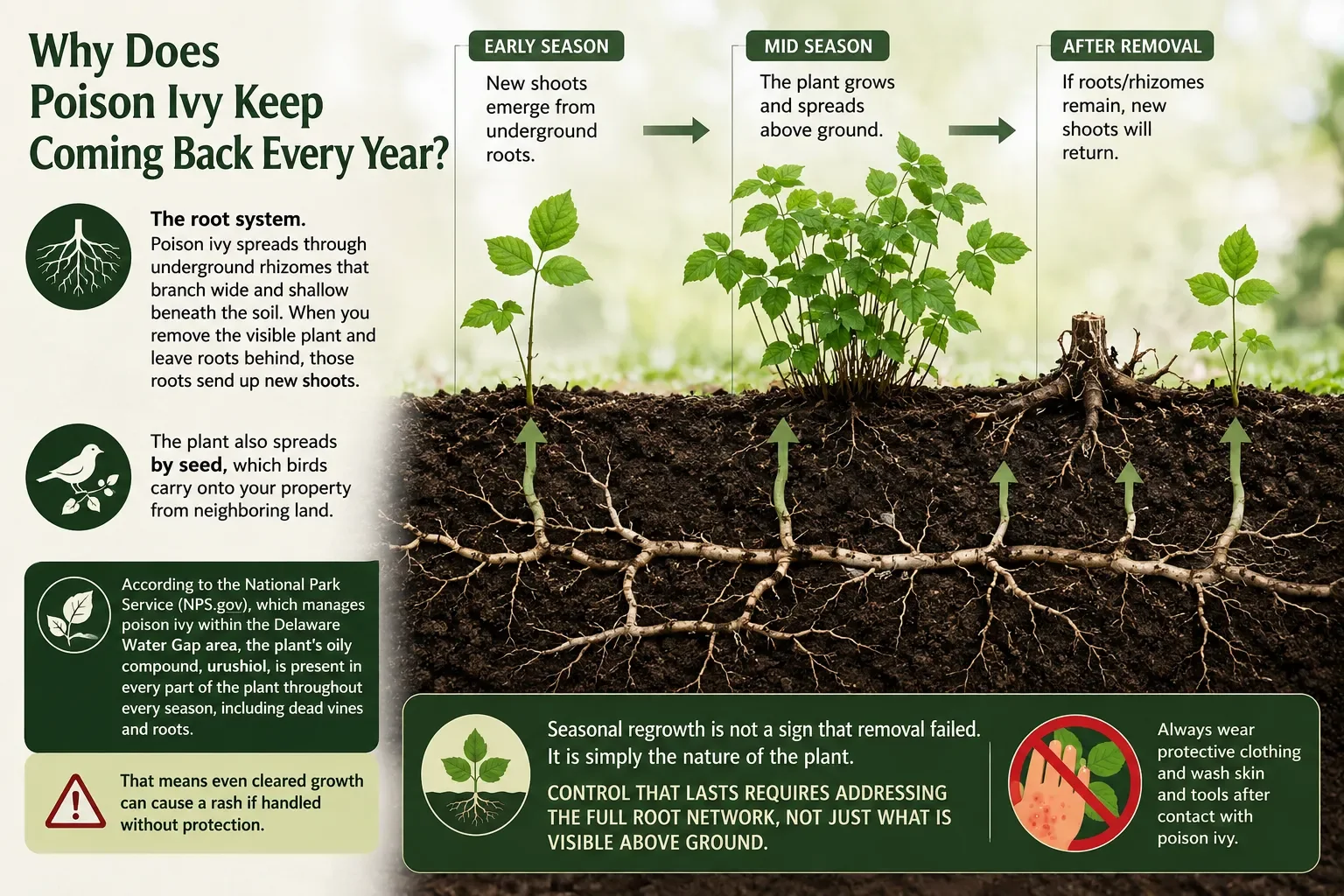
According to the National Park Service (NPS.gov), which manages poison ivy within the Delaware Water Gap area, the plant's oily compound, urushiol, is present in every part of the plant throughout every season, including dead vines and roots. That means even cleared growth can cause a rash if handled without protection.
Seasonal regrowth is not a sign that removal failed. It is simply the nature of the plant. Control that lasts requires addressing the full root network, not just what is visible above ground.
When Is the Best Time to Treat Poison Ivy in Delaware Valley?
Late spring through early summer is the most effective treatment window. The plant is actively growing, leaves are fully open, and systemic herbicides absorb more efficiently through green foliage at this stage. Treatments applied during this period reach the root system more reliably than those applied late in the season.
That said, poison ivy can be identified and treated through fall as long as leaves are still present. Dormant vines in winter are harder to treat chemically but can still be cut back and the roots addressed manually with the right protective gear.
Effectivepoison ivy control in Delaware Valley accounts for the full growing cycle, not just a single application in one season.
What Are the Safest Ways to Control Poison Ivy on Your Property?
For small, young plants in an accessible area, hand removal is an option. Use waterproof gloves, long sleeves, and eye protection. Dig down to get the roots rather than pulling stems at the surface. Seal all plant material in heavy plastic bags for trash disposal. Never burn poison ivy. The smoke carries urushiol into the air and can cause serious respiratory reactions when inhaled.

For established growth, systemic herbicides containing triclopyr or glyphosate are effective. Triclopyr is generally preferred near lawns because it targets broadleaf plants without harming grass. Apply on a calm, dry day during active growth. Multiple applications are usually needed for older, deep-rooted plants.
Smothering with plastic sheeting can slow small patches but rarely works on established growth. Natural sprays made from vinegar and salt kill surface foliage but do not reach the roots, so regrowth typically follows within weeks.
How Do You Stop Poison Ivy from Spreading to New Areas?
Monitor your property regularly, particularly along fence lines, tree bases, and any wooded or shaded edges. These are the spots where seeds dropped by birds tend to germinate first.
Address small new growth immediately. A seedling caught early is a five-minute job. The same plant left until the following season is a rooted problem that takes considerably more effort to clear.
Properties with shared boundaries are especially vulnerable to reintroduction from neighboring land. This is one reason why poison ivy control in Delaware Valley often requires follow-up visits rather than a single clearing.
When Does Poison Ivy on a Property Need Professional Help?
When the growth is extensive, climbing, recurring, or located in areas where children and pets spend time. Hand removal and spot-spraying have limits, particularly for vines that have grown into tree canopy, along long fence runs, or through established shrubs where targeted treatment is difficult without damaging surrounding plants.
Professional poison ivy control services in Delaware Valley handle the full process: identifying all growth stages, treating the root system, disposing of plant material safely, and monitoring for regrowth across seasons. For homeowners who have dealt with the same patches returning year after year, this is the approach that actually ends the cycle.